Kedai kurma is simply Malay for a date shop. If you are looking for one in Kuala Lumpur, the question you will probably end up asking at the counter is which of these boxes is worth the money. This guide doesn’t point you to a particular shop. It covers what you can check yourself on the shelf: which variety you are holding, where it comes from, what the grade letters mean, how soft dates should be stored, and what a fair price looked like in one wholesaler’s list in November 2026. Knowing those few things is what separates quality dates from an expensive guess.
One fact frames everything else. Malaysia has no commercial date-growing trade, so every date on a Kuala Lumpur shelf has been imported. The label tells you where from, and that is the first thing worth reading.
Four varieties you are likely to be shown
The varieties below are the four this article has always covered. Each has a known origin and a texture you can check with your own eyes and fingers.
Medjool
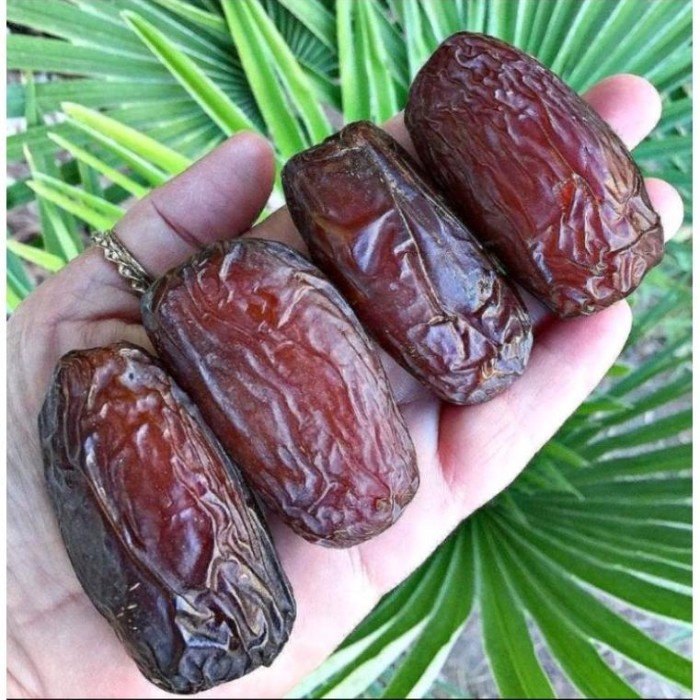
Medjool originated in Morocco. An FAO handbook on the date palm records that every Medjool palm in the world traces back to a single palm at Bou Denib in Morocco. The fruit is large and very soft, with a rich caramel taste. In the price list used further down, all nine Medjool listings named Palestine (some spelled it Palestin).
Deglet Noor
Deglet Noor comes from Tunisia and Algeria. It is golden, translucent and semi-dry. When it is sold still attached to the stem, Malaysian shops call it kurma tangkai. The stem is just how it was packed. It says nothing about the date coming from Madinah.
Ajwa
Ajwa comes from Madinah in Saudi Arabia, and “Kurma Nabi” is a market name for it. Look for a small, roundish, near-black date with finely wrinkled skin. It should be soft.

Safawi
Safawi dates come from the Madinah region of Saudi Arabia. They are longer than Ajwa, dark brown to black, soft and chewy. Next to a roundish Ajwa, Safawi is the longer date.
What one wholesaler’s list showed in November 2026
Prices change, so a reference point helps. Here is how these four varieties looked in one Malaysian wholesaler’s price list, checked in November 2026. The per-kilo figures are each pack’s price divided by its weight.
| Variety | Origin | Texture | Listings in stock | In-stock price per kg |
|---|---|---|---|---|
| Medjool | Originated in Morocco; listings named Palestine | Large, very soft | 5 of 9 | RM56 to RM77.78 |
| Deglet Noor | Tunisia / Algeria | Golden, semi-dry | 1 of 10 | RM18.33 |
| Ajwa | Madinah, Saudi Arabia | Small, near-black, soft | 5 of 13 | RM23 to RM44 |
| Safawi | Madinah region, Saudi Arabia | Dark, soft and chewy | 7 of 9 | RM16 to RM45 |
A few details from that list are worth knowing before you shop. The cheapest Medjool per kilo that was actually in stock was a 5kg Premium Jumbo pack at RM280. The single 900g Medjool box at RM70 was the dearest per kilo. The only Deglet Noor in stock was a pack of twelve 400g packets on the stem at RM88. Safawi had the most listings in stock of the four. Per kilo they ran from RM16, for a 5kg A No.2 (Mini) pack at RM80, to RM45 for a 1kg AAA Jumbo pack.
Ajwa shows why you should compare per kilo and not per pack. A 1kg pack of Ajwa A was RM31. The 5kg A No.1 (Small) pack was RM115, which works out at RM23 a kilo. Those two are not labelled the same grade, so the cheaper kilo is not automatically the same fruit.
Every one of these listings was marked down from a higher regular price on the day it was checked. If a kedai kurma quotes you a price, ask whether it is a sale price and what the pack weighs, then do the division yourself.
What the grade letters mean, and what they don’t
Boxes are often marked A, AA, AAA, Jumbo or VIP. These are not an international standard. Each importer sorts fruit by size in its own way, so an AA box from one supplier is not necessarily the same as AA from another. Our Malay post on region names printed on date labels goes further into reading the rest of the box.
The FAO handbook describes how packing houses grade dates in two stages. First the fruit is split into Grade A (perfect fruit), Grade B (fruit with skin separation), Grade C (for pitting and industrial use) and Grade D (rotten and damaged fruit). Grade A is then sorted by size into jumbo, large and medium. For Medjool in Israel, FAO gives the size bands by weight: Jumbo above 23g, Large 18g to 23g, Medium 15g to 18g. It adds that other countries, the USA for example, use different definitions. That is a good reason not to assume two Jumbo labels mean the same size.
Loose skin on a Medjool can look worrying. FAO calls loose skin an aesthetic defect rather than a taste defect, and says the same of the sugar crystals that sometimes form under it. If you are buying for your own kitchen, a little loose skin costs you nothing in flavour.
Soft dates, dry dates and how they are kept
Two Arabic words turn up on labels. Rutab (often spelled rotab) is the soft, fresh-ripe stage. Tamr, or tamar, is the fully ripe, drier stage. FAO notes that dates at every stage before tamar are perishable because of their high water content, and that rutab fruit turns sour quickly unless it is cold stored.
Some soft varieties need cold storage. Mazafati from Bam in Iran, sold as Rotab Mazafati or kurma madu, is dark, very soft and needs refrigeration. It is cold-stored and sold all year, so seeing rotab outside harvest time is normal and nothing to be suspicious about. For long-term storage, FAO says −18°C is now commonly used for several varieties, Medjool included.
On the label, FAO’s handbook states that in most importing countries the law requires the weight, country of origin, quality and expiry date to appear on the pack. If any of those is missing from a box, ask about it before you pay.
When to shop
Demand for dates in Malaysia peaks before and during Ramadan. Hari Raya, weddings (hantaran), kenduri and umrah gifts bring other busy periods. Gulf and Middle-East dates are mostly harvested from late summer to autumn, and new-season stock reaches Malaysia some weeks later. If you are buying in bulk for an event, check stock and prices early and again close to the day.
Shop counter or online
A kedai kurma lets you see and squeeze the fruit before you pay. Online, you can line up several listings and compare their per-kilo prices. Our Malay guide to buying dates in a shop or online with confidence walks through both. If you need larger quantities, the post on finding a kurma wholesaler in Shah Alam covers what to ask a supplier.
Quick questions
Is AA from one shop the same as AA from another?
Not necessarily. Grade letters are each importer’s own size sorting, not an international standard.
Is Kurma Nabi a different variety from Ajwa?
No. Kurma Nabi is a market name for Ajwa, from Madinah.
Does kurma tangkai mean the dates are from Madinah?
No. Kurma tangkai is Deglet Noor sold on the stem, and Deglet Noor comes from Tunisia and Algeria.
Why is rotab Mazafati on sale outside harvest season?
Mazafati is cold-stored and sold year-round, so finding it at any time of year is normal.
Next time you stand at a kedai kurma counter in Kuala Lumpur, read the variety, the origin, the weight and the grade, and work out the price per kilo before choosing. More about this site is on the About Us page and the contact page.